
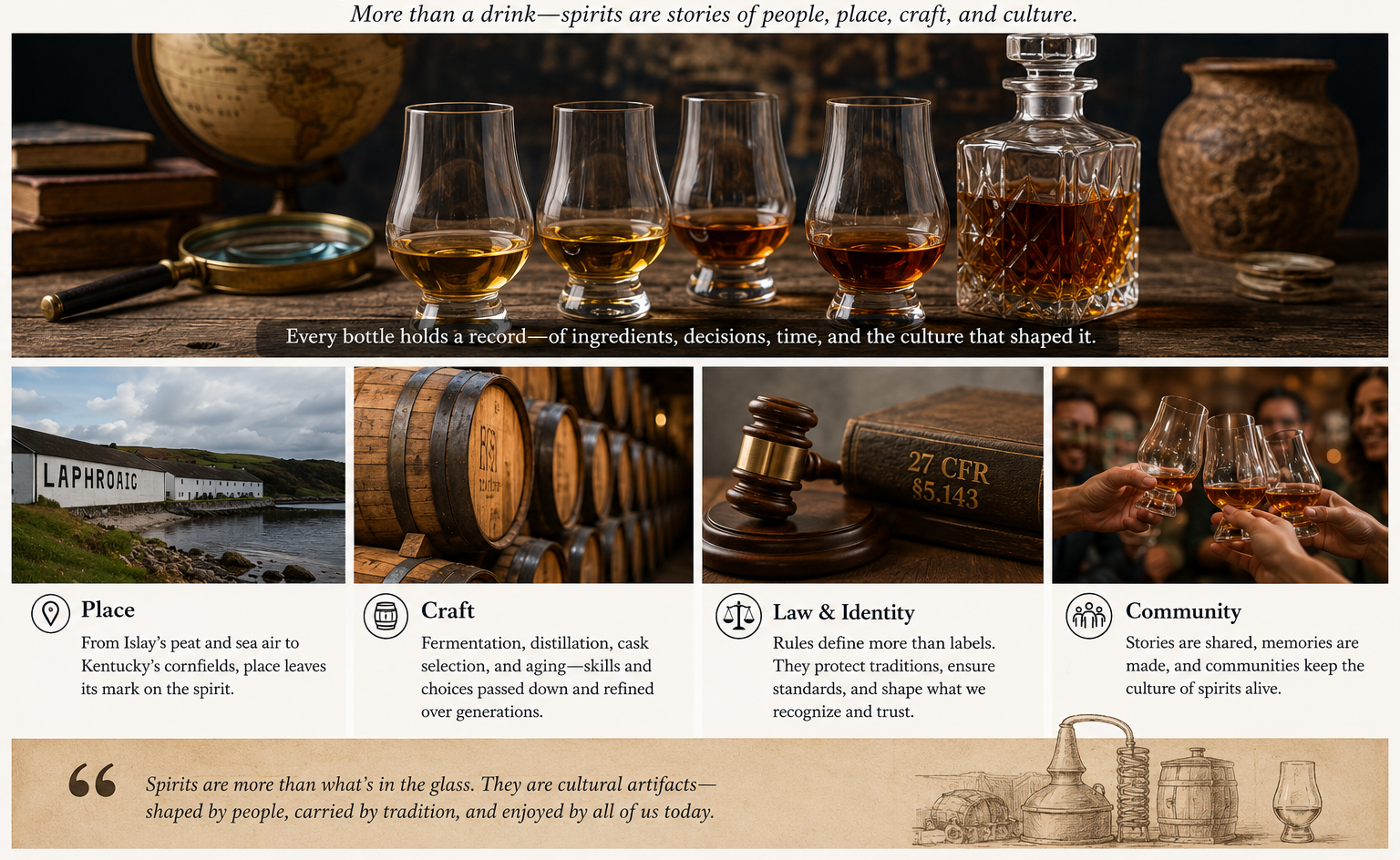
They are made from grain, fruit, sugarcane, water, yeast, wood, fire, time, labor, law, trade, climate, and memory. Every bottle carries a record of decisions: what was grown, how it was fermented, how it was distilled, what kind of cask held it, how long it aged, where it traveled, and who decided it was ready to pour.
That is why I think of spirits as cultural artifacts.
An artifact is not only something old in a museum case. It is an object shaped by human hands, human choices, and human meaning. A bottle of whisky, bourbon, rum, cider, brandy, or any other spirit can tell us about agriculture, technology, commerce, ritual, identity, celebration, status, memory, and place.
That is the heart of The Cultured Pour.
More Than Flavor
Tasting notes matter. Flavor is often the first thing that pulls us in.
We notice smoke, oak, caramel, fruit, spice, sweetness, heat, dryness, salt, leather, vanilla, char, or bitterness. We decide whether something is balanced, harsh, refined, simple, complex, comforting, or memorable.
But flavor does not appear from nowhere.
A smoky Islay Scotch carries the story of peat, place, maritime climate, distillery tradition, and modern expectations of what Islay whisky should be. Scotch itself is legally tied to place: the Scotch Whisky Association explains that Scotch Whisky is protected as a geographical indication, and its traditional regional and locality names include Highland, Lowland, Speyside, Islay, and Campbeltown.
Bourbon carries a different kind of story. It is tied to corn, charred new oak, American law, warehouse aging, regional identity, and changing consumer taste. U.S. federal standards define bourbon whiskey by requirements such as a mash of at least 51 percent corn, distillation and barrel-entry proof limits, and storage in charred new oak containers.
Rum can carry the history of sugar, colonial trade, labor, empire, blending, and tropical maturation. Cider can connect directly to orchards, harvest cycles, apple varieties, farming communities, and local foodways.
When we taste thoughtfully, we are not only tasting flavor. We are tasting context.
Spirits as Place
Some bottles taste strongly of where they come from.
That does not mean every flavor can be reduced neatly to geography. Production choices matter. Branding matters. Cask management matters. Law matters. Consumer expectation matters. But place still has power.
Water source, climate, grain, fruit, warehouse conditions, local tradition, and regional regulation can all shape how a spirit is made and understood. Even when the connection to place is partly romanticized, the idea of place still influences how people talk about a bottle.
This is one reason I respond strongly to spirits with a clear identity. I like bottles that feel rooted in something specific.
Laphroaig feels different from Talisker. Talisker feels different from Glenfiddich. A structured Demerara rum feels different from a polished Speyside whisky. A bright fruit cider carries a different kind of cultural meaning than a barrel-strength bourbon.
That difference is part of the pleasure.
Spirits as Craft
Every bottle is also a record of craft.
Someone chose the raw material. Someone controlled fermentation. Someone made cuts during distillation. Someone selected the casks. Someone monitored aging. Someone blended, proofed, bottled, marketed, and released the final product.
Even industrial spirits involve craft decisions. Some are made to be consistent and accessible. Others are built to highlight a cask, a year, a finish, a distillery character, or an experiment.
UNESCO describes intangible cultural heritage as practices, knowledge, skills, and expressions that communities recognize as part of their cultural heritage. It also emphasizes that the value of intangible heritage is not only the visible product, but the knowledge and skills transmitted through it.
That matters when thinking about spirits. Distilling, blending, coopering, farming, tasting, and maturation are not just technical steps. They are bodies of knowledge. They are learned, practiced, repeated, adapted, and passed along.
This is why I care about more than a number score. A spirit can be technically interesting and still not work for me. Another can be simple but perfectly suited to its role. A bottle like Blade and Bow works for me because it succeeds as an everyday bourbon. A bottle like Glenfiddich Winter Storm works because it feels like a complete and refined experiment. A bottle like New Louisville Barrel House JB37 “Cake Daddy” works best neat, but loses something when diluted.
Those distinctions matter. They are part of the craft story.
Spirits as Law and Identity
One of the most interesting things about spirits is that identity is often defined by law.
Bourbon is not just a flavor. It is a legal category. Scotch is not just whisky made in a certain style. It is protected by law and tied to Scotland. Regional terms like Islay, Speyside, Highland, Lowland, and Campbeltown are not just marketing language; they are part of how Scotch is officially organized and protected.
These rules do more than regulate labels. They shape culture.
They influence what producers can make, what drinkers expect, what collectors value, and what communities protect. They also show how spirits become part of national and regional identity.
When people argue about what counts as bourbon, Scotch, rum, Japanese whisky, single malt, craft, sourced, or authentic, they are not only arguing about liquid. They are arguing about identity, tradition, trust, and meaning.
That is cultural territory.
Spirits as Ritual
People rarely drink spirits only for flavor.
We drink to mark time, celebrate, remember, gather, learn, relax, compare, share, and sometimes to connect with a place or person. A bottle opened with friends becomes part of a memory. A tasting flight becomes a lesson. A special release becomes part of a community conversation. An everyday bottle becomes part of a routine.
This does not mean drinking should be careless. Spirits deserve respect, and responsible enjoyment matters.
But responsible enjoyment can still recognize that spirits have social meaning. They appear at holidays, weddings, retirements, reunions, tastings, dinners, campfires, bars, distilleries, and quiet evenings at home. The context changes the experience.
The same pour can mean different things depending on where it is, who it is shared with, and why it was opened.
Spirits as Community
The spirits world is full of communities.
There are bourbon hunters, Scotch drinkers, rum enthusiasts, cider makers, bartenders, home tasters, collectors, historians, distillers, farmers, writers, and casual drinkers who simply know what they like.
Communities shape how spirits are talked about. They decide which bottles become sought after, which stories get repeated, which styles become fashionable, and which producers earn trust. They also influence prices, hype, access, and expectations.
This is why commentary matters to me.
Spirits news is not only business news. A distillery expansion, limited release, brand acquisition, closure, law change, label controversy, or new cask experiment can affect drinkers, producers, retailers, collectors, educators, and local communities.
I am interested in those effects.
Not just what happened — but why it matters.
Spirits as Memory
A tasting note is a memory device.
It captures a moment when a bottle met a palate. It records not only what was tasted, but what stood out. Sometimes the note is technical. Sometimes it is emotional. Sometimes it is practical: buy again, avoid, drink neat, do not add ice, save for dessert, share with friends.
My own notes have collected over several years. Some are formal. Some are remembered impressions. Some are tied to bottles I may never find again. That is part of the archive.
A tasting record does not need to be perfect to be useful. It needs to be honest.
Over time, patterns emerge. I learned that I love distillery-led peat more than generic peat. I learned that sweetness works for me when it has structure. I learned that a 10/10 bottle can be a special Scotch, an everyday bourbon, or a bright fruit cider. Those patterns tell me something about my palate, but they also tell me something about how spirits create meaning through repetition and memory.
Why This Site Exists
The Cultured Pour exists because I do not want to separate flavor from story.
A bottle can be reviewed as a drink, but it can also be understood as an object of craft, culture, and history. That does not mean every review has to be academic. It means every pour has more than one layer.
My goal is to explore those layers honestly.
I want to know:
- What does it taste like?
- What role does it play?
- Would I return to it?
- What does it tell us about craft?
- What does it say about place?
- How does it connect to history or community?
- Why does it matter to the people who drink it?
That is the space where this site lives.
Final Thought
Spirits are not just bottles on a shelf.
They are records of ingredients, tools, labor, law, trade, geography, tradition, marketing, memory, and taste. They are made by people, shaped by culture, and given meaning by the communities that drink them.
To me, that makes them cultural artifacts.
And every pour is worth asking about.
Sources and Further Reading
- Scotch Whisky Association — Scotch Whisky legal protection and geographical indication status.
- Scotch Whisky Association — Scotch Whisky regions and traditional locality protections.
- U.S. Code of Federal Regulations / TTB materials — federal standards for bourbon whiskey and straight bourbon whiskey.
- UNESCO — Intangible cultural heritage, traditional knowledge, skills, and cultural practices.


Leave a Reply