
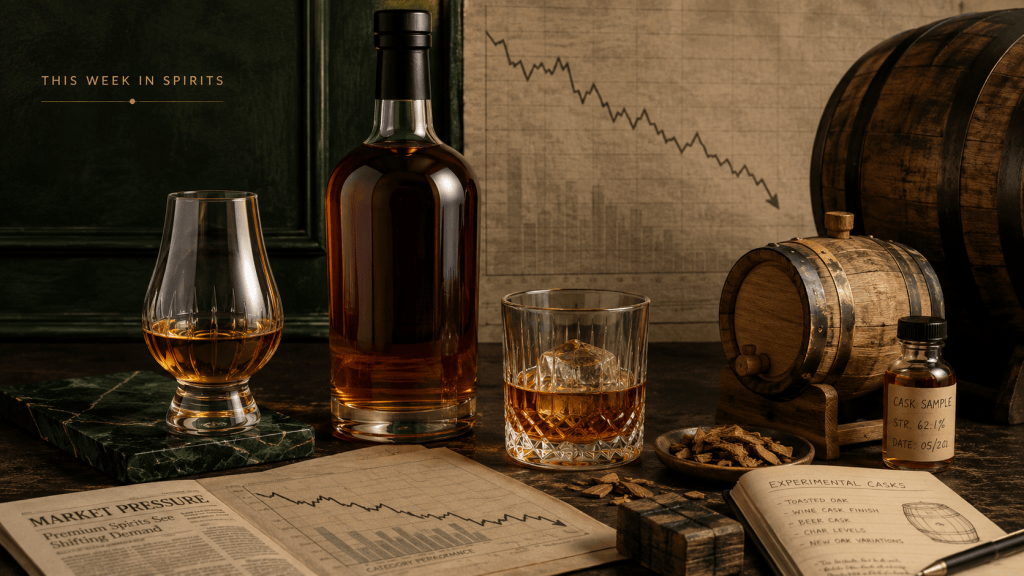
This week’s spirits news had a little bit of everything: ultra-aged Scotch, bourbon business pressure, experimental finishes, celebrity-backed whiskey, and another reminder that the local taproom model can be fragile.
That mix is exactly why spirits are worth watching beyond the bottle. A new release is not just a new release. A business story is not just a balance sheet. These stories shape what people can buy, what distilleries choose to make, how brands talk to drinkers, and how communities gather around spirits.
Here are the stories that stood out to me this week.
The Balvenie Pushes Ultra-Aged Whisky Even Further
The Balvenie is preparing to release an 88-year-old single malt Scotch, reportedly the world’s oldest single malt, with only 17 bottles available and an estimated private-sale price of £200,000–£250,000. The whisky was distilled in 1931 and matured in a single sherry cask until 2019. (Financial Times)
My take: releases like this are less about everyday drinking and more about whisky as luxury object, art piece, and historical artifact. That does not make them meaningless. In fact, they say a lot about where the upper end of whisky culture has gone. Age, rarity, packaging, and story are all part of the product.
But the question I always come back to is simple: does older mean better? Not automatically. Ultra-aged whisky can be fascinating, but maturation is not just a stopwatch. Too much oak, too much evaporation, or too much emphasis on prestige can move the conversation away from flavor and toward status.
For the community, this kind of release will probably be admired from a distance. Most drinkers will never taste it. But it still shapes the way people talk about value, rarity, and what counts as “important” whisky.
Bourbon’s Business Pressure Is Still Real
Pernod Ricard reported weaker performance in major markets, including declines of 14% in the U.S. and 19% in China for the fiscal year ending June 30. The company also warned that U.S. growth may remain limited over the next few years. (Reuters)
This fits a broader story we have been seeing across whiskey and spirits: the post-boom market is changing. Consumers are more cautious, some younger drinkers are drinking less, and premium bottles are facing more pressure.
My take: this does not mean bourbon or whisky is dying. It means the easy-growth period is over. Brands that relied on hype, constant limited releases, or automatic premiumization may have to work harder to justify price and quality.
For drinkers, that may not be all bad. A softer market can eventually mean better availability, more realistic pricing, and less pressure to chase every bottle. For producers, especially smaller ones, it can be much harder.
Brown-Forman Shows the Pressure Behind Heritage Brands
Brown-Forman, the company behind Jack Daniel’s, is reportedly dealing with family tensions, leadership pressure, declining shares, and takeover interest, including a rejected Sazerac bid. (Wall Street Journal)
My take: this is a good reminder that heritage brands are still businesses. The labels may talk about legacy, family, place, and tradition, but behind that are ownership structures, market pressure, shareholder expectations, and strategic decisions.
For the community, the concern is what happens when iconic brands get pushed by financial pressure. Do they protect quality? Do they chase growth? Do they simplify portfolios? Do they sell? These decisions eventually reach the shelf.
Angel’s Envy Experiments With Amburana and Imperial Stout
Angel’s Envy announced a new limited bourbon in its 2026 Distillery Series, finished with imperial stout and a very small portion of amburana-finished whiskey. Only about 1% of the final blend is amburana-finished, which makes sense because amburana can dominate a whiskey quickly. The release is planned as a 375 ml distillery-only bottle at $54.99. (Food & Wine)
My take: I like the restraint here. Amburana can be exciting, but it can also taste like the cask is shouting over the whiskey. Using only a small amount suggests Angel’s Envy knows the wood is powerful.
This is the kind of experiment I respect when it is done carefully. My own tasting notes have taught me that experiments work best when they feel finished and integrated. Glenfiddich Winter Storm worked for me because the sweetness felt refined. Glenfiddich Fire & Cane did not work for me because it felt rushed and underdeveloped. The difference is not whether a brand experiments. The difference is whether the experiment serves the spirit.
Celebrity Whiskey Continues to Expand
Chris Hemsworth has joined Australian distillery Archie Rose as a co-owner ahead of the brand’s U.S. launch. The company is emphasizing Australian ingredients, sustainability, and local production as part of its global story. (People)
My take: celebrity involvement in spirits can go either way. Sometimes it feels like a quick marketing play. Sometimes it brings attention to a producer that already has a real story.
The important question is whether the celebrity becomes the product, or whether the spirit still has its own identity. If Archie Rose can use the attention to highlight Australian grain, climate, production, and flavor, then the partnership may help introduce more drinkers to Australian whiskey as a category.
A Local Taproom Closure Shows the Pressure on Small Producers
Waypoint Spirits in Bloomfield, Connecticut, closed its taproom after five years, though the company plans to continue production and distribution. The closure comes alongside other local beverage-business closures in the state, including cider and brewery taprooms. (CT Insider)
My take: this is the kind of story that matters locally even if it does not make national headlines. Taprooms are not just sales channels. They are community spaces. They introduce people to local producers, host events, create regulars, and give small distilleries a direct relationship with drinkers.
When taprooms close but production continues, the brand may survive, but the community experience changes. That is worth paying attention to especially in your local areas. As the decline of alcohol consumption trends upward the local space of alcohol culture will decline with it.
What I’m Watching
The larger pattern this week is tension.
On one side, you have ultra-premium releases, celebrity launches, and experimental finishes. On the other, you have market softness, internal pressure at major companies, and local taprooms closing.
That contrast says a lot about where spirits are right now. The top end is still chasing rarity, story, and spectacle. The middle of the market is under pressure. Small producers still need community support. Drinkers are being asked to decide what is actually worth their money and attention.
For me, the most interesting spirits stories are not only about what is new. They are about what each release or business decision says about the culture around drinking.
That is what I want Pour Perspective to be: not just a roundup of headlines, but a way to ask what these stories mean for drinkers, producers, and the communities around them.


Leave a Reply